

Why do successful companies become slower as they grow?
When Satya Nadella became CEO of Microsoft in 2014, one of the world's most successful technology companies faced a problem that had little to do with technology. Business units competed instead of collaborating, overlapping products were developed independently and decisions increasingly reflected local priorities rather than enterprise objectives. Microsoft wasn't alone. Adobe encountered a similar challenge while reinventing its business model, and Amazon faced it as rapid expansion increased organisational complexity.
Successful companies rarely become slower overnight. In most cases, organisational performance begins changing long before financial performance does.
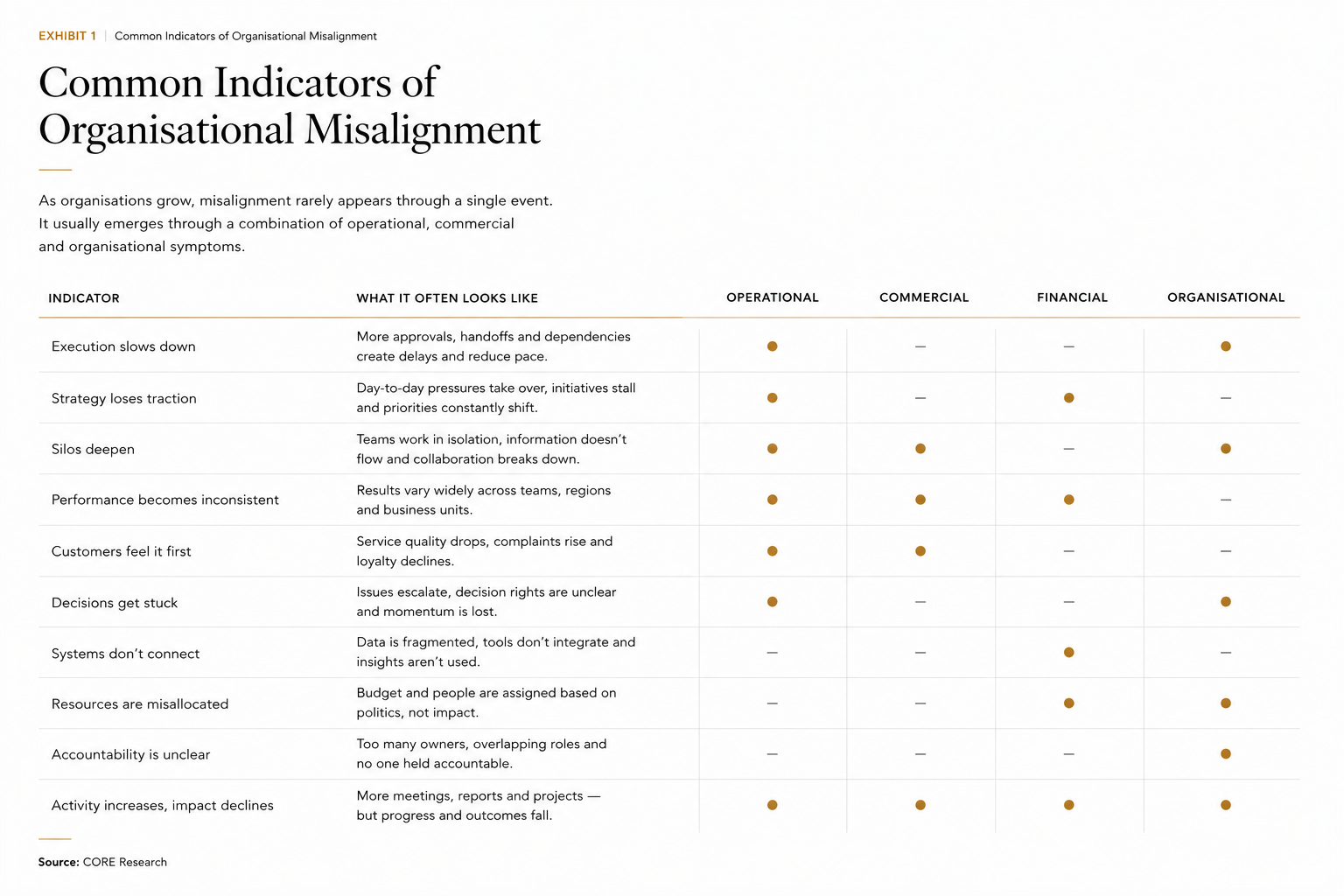
As organisations grow, misalignment rarely appears through a single event. It usually emerges through a combination of operational, commercial and organisational symptoms.
No single indicator confirms organisational misalignment. However, when several of these patterns begin appearing together, organisations often find that execution slows despite continued investment in people, technology and capability. The symptoms themselves aren't new.
Growing organisations have struggled with coordination for decades. What has changed is the speed at which misalignment affects performance.
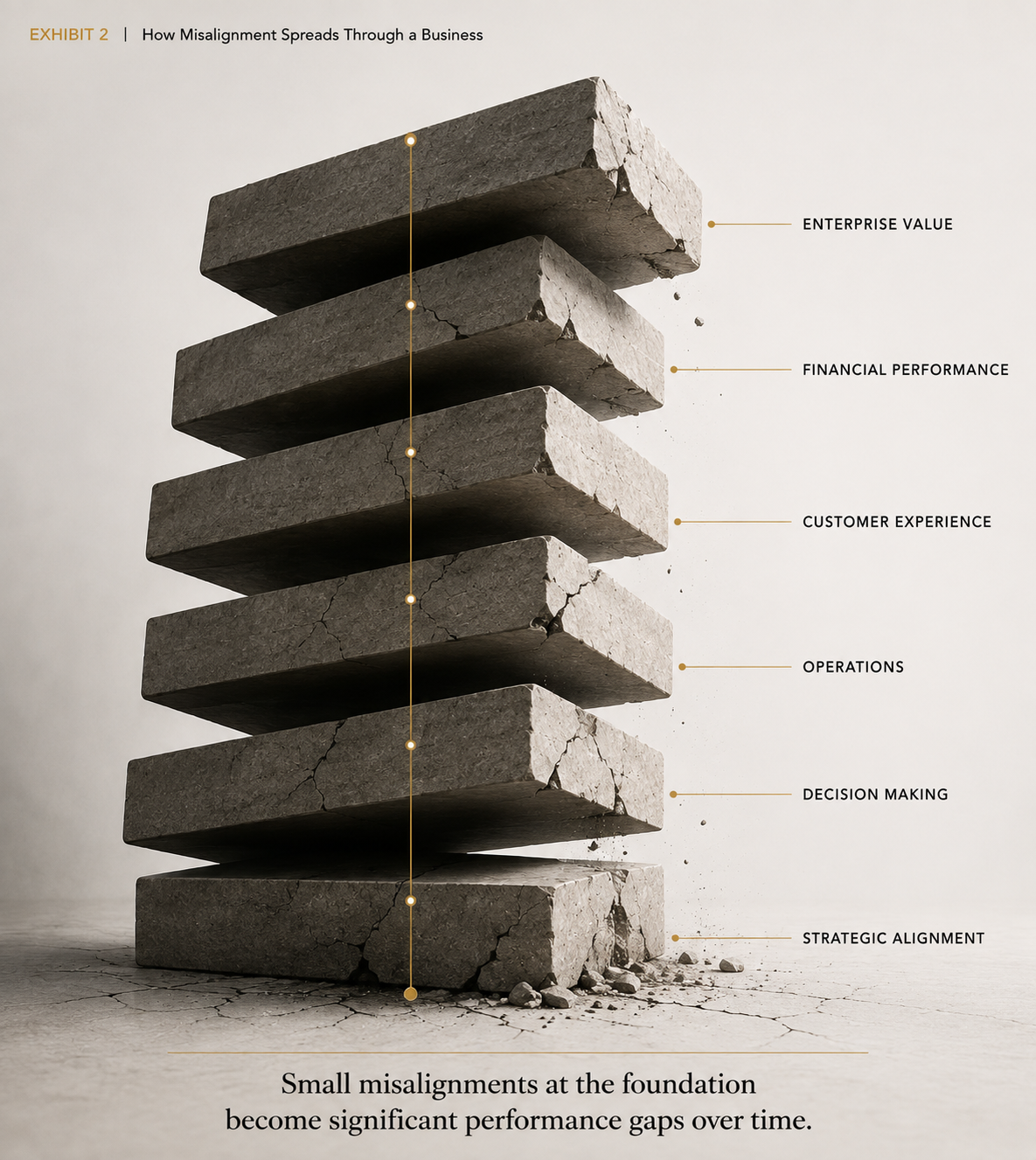
Digital businesses launch products faster, supply chains span multiple regions, customers move between channels in real time and artificial intelligence is accelerating how quickly decisions can be made. The business has become increasingly interconnected. The operating model often hasn't.
Many organisations respond by investing in technology, creating new governance structures or introducing additional reporting. These initiatives improve visibility, control or efficiency within individual functions, but they rarely address how decisions move across the organisation.
The result is a familiar contradiction. Individual departments continue improving, while executing initiatives that span the organisation becomes increasingly difficult.
The consequences extend beyond slower decision-making. McKinsey estimates that strategic planning, budgeting and performance reviews alone consume 40–65% of management and overhead time in many organisations.McKinsey & Company
Shared business outcomes
One of the first changes organisations make as they scale is shifting the focus from functional performance to business performance. Microsoft provides a good example. Under Satya Nadella, the company moved away from internal competition between business units and placed greater emphasis on collaboration across teams. The objective wasn't simply to improve engineering, sales or product development individually. It was to ensure those functions were contributing to the same strategic outcome.
The same principle can be seen in Adobe's transition to Creative Cloud. Success was no longer measured by software licences sold in a single quarter, but by customer adoption, retention and recurring revenue over time. Achieving those outcomes required sales, finance, product and customer success to optimise the same business objective rather than separate departmental targets.
By redefining success around shared business outcomes rather than isolated departmental targets, Microsoft and Adobe reduced one of the most common sources of organisational misalignment: teams optimising different definitions of success.
Clear decision ownership
As organisations grow, decision-making often becomes distributed across more teams, functions and management layers. While this can improve oversight, it can also slow execution when ownership becomes unclear. Amazon addressed this by introducing the concept of the "single-threaded leader"—an individual given end-to-end responsibility for a specific initiative without competing priorities.
The objective wasn't to reduce collaboration; large initiatives still required input from multiple functions. It was to ensure that accountability remained clear even as coordination became more complex. Many organisations respond to slower execution by adding committees, approvals or reporting. The companies that sustain speed tend to do the opposite: clear ownership reduces the conflicting priorities that emerge when multiple teams share responsibility but no single team owns the outcome.
Connected performance measures
Performance metrics influence behaviour more than strategy documents ever will. If one team is rewarded for increasing revenue while another is measured primarily on reducing costs, conflicting decisions are often inevitable.
Adobe encountered this challenge during its transition to Creative Cloud. Under the traditional licensing model, success was largely measured at the point of sale. A subscription business required a different perspective, where customer retention, product adoption and long-term recurring revenue became just as important as acquiring new customers. Rather than introducing a new set of isolated KPIs, Adobe gradually aligned performance measures with the economics of the new business model.
When performance measures evolve with the business model, departments are less likely to optimise competing objectives at the expense of enterprise performance.
Integrated operating mechanisms
Strategy is rarely undermined by a lack of ambition. More often, it is weakened by planning, budgeting, reporting and performance reviews operating independently of one another. Toyota's production system is frequently cited not because of a single manufacturing technique, but because planning, quality, operations and continuous improvement were designed to reinforce the same objectives. Problems were surfaced immediately, ownership was clear and improvements became part of everyday operations rather than standalone initiatives.
The most effective operating models don't rely on exceptional coordination between disconnected processes. When planning, budgeting and performance management reinforce the same strategic priorities, organisations reduce the risk of different functions moving in different directions despite pursuing the same strategy.
Continuous adaptation
The operating model that supports one stage of growth rarely supports the next. Netflix offers one example. As the company expanded from DVD rentals to global streaming and then content production, it repeatedly adapted how teams were organised, how decisions were delegated and how talent was managed. The business changed significantly over two decades, and the organisation changed with it.
Many companies redesign products, enter new markets or adopt new technologies while leaving management structures largely unchanged. Over time, the gap between how the business creates value and how it is organised to deliver that value continues to widen.
Organisations that regularly adapt the way they operate are better positioned to realign priorities before fragmentation begins affecting execution.
Growth creates opportunity. It also creates the conditions for priorities to drift apart.
The companies that continue executing effectively don't rely on alignment happening naturally. They recognise that every new product, market, acquisition and capability introduces new priorities that must be deliberately connected to the organisation's broader objectives.
As businesses become more complex, sustaining performance depends less on optimising individual functions and more on ensuring that every part of the organisation continues working towards the same outcome.